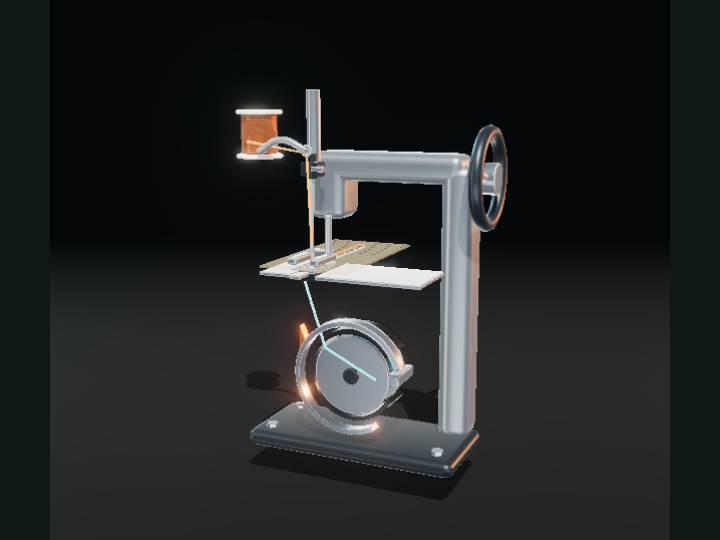
As the needle begins to rise, the cloth holds back part of the thread. A small loop opens beside the needle, just below the fabric.
That brief loop gives the hook something to catch. The needle’s scarf provides clearance near the hook.
TRY IT YOURSELF
Choose Loop below the model. Follow the orange thread on the rising side of the needle.
Go deeper +
Real loop formation depends on thread, cloth friction, needle shape and tension. Here the curve is staged explicitly, rather than calculated from those forces.
The hook spreads the orange loop around the bobbin case. The bobbin supplies the cyan lower thread. The upper thread passes around it before the loop is pulled closed.
Two threads can interlock even though neither spool passes through the cloth. The small clearances around the case let the upper loop travel.
TRY IT YOURSELF
Select Around bobbin and rotate the model. Trace the orange loop around the case, not through its metal.
Go deeper +
Thread thickness and clearances are enlarged for inspection. The two paths illustrate the topology of an interlock, not a validated thread-dynamics simulation.
The take-up lever rises, drawing the upper thread back. The loop slips free of the hook and tightens around the lower thread inside the fabric.
Controlled tension brings the interlock into the material instead of leaving a loose loop underneath.
TRY IT YOURSELF
Select Tighten. Follow the upper thread back toward the moving take-up lever.
Go deeper +
The visible stitch is an interlock, not a separate overhand knot. Real tension balance varies with fabric and thread. This exhibit does not calculate tension.
Once the needle is clear, the feed dogs rise, grip the cloth and move it forward. They drop below the plate to return without dragging the fabric backward.
The feed distance sets the space between stitches. The presser foot holds the cloth against the feed and plate.
TRY IT YOURSELF
Compare 1, 2 and 4 mm. Watch the completed stitch spacing change while the needle keeps the same stroke.
Go deeper +
A full drive-shaft turn produces one modeled stitch. Scene scale is 0.16 teaching units per millimetre of feed. The moving strip is reconstructed from phase; no history is accumulated.
Schematic overview. The explanation and equations remain available without JavaScript or 3D.
CHAPTER 1
A needle carries a loop.
The needle carries the orange upper thread down through the cloth. Its eye is near the pointed end, so the whole needle does not need to pass through.
A sewing machine needs to leave thread behind while bringing the needle back. That takes a second thread and a hidden mechanism.
The animation follows an idealized oscillating-hook lockstitch. The needle, feed and hook share a prescribed cycle.
CHAPTER 2
Coming back makes a loop.
As the needle begins to rise, the cloth holds back part of the thread. A small loop opens beside the needle, just below the fabric.
That brief loop gives the hook something to catch. The needle’s scarf provides clearance near the hook.
Real loop formation depends on thread, cloth friction, needle shape and tension. Here the curve is staged explicitly, rather than calculated from those forces.
CHAPTER 3
A hook arrives at the right moment.
The pointed hook passes the needle and catches its loop. The hook oscillates: it sweeps around, then returns for the next stitch.
The hook must meet the loop after the needle reverses. Arrive too early or late in a real machine and a stitch can be missed.
This is an oscillating-hook mechanism, not the continuously rotating hook used in some other lockstitch machines.
CHAPTER 4
The second thread stays underneath.
The hook spreads the orange loop around the bobbin case. The bobbin supplies the cyan lower thread. The upper thread passes around it before the loop is pulled closed.
Two threads can interlock even though neither spool passes through the cloth. The small clearances around the case let the upper loop travel.
Thread thickness and clearances are enlarged for inspection. The two paths illustrate the topology of an interlock, not a validated thread-dynamics simulation.
CHAPTER 5
Take back the slack.
The take-up lever rises, drawing the upper thread back. The loop slips free of the hook and tightens around the lower thread inside the fabric.
Controlled tension brings the interlock into the material instead of leaving a loose loop underneath.
The visible stitch is an interlock, not a separate overhand knot. Real tension balance varies with fabric and thread. This exhibit does not calculate tension.
CHAPTER 6
One stitch. Then a small step.
Once the needle is clear, the feed dogs rise, grip the cloth and move it forward. They drop below the plate to return without dragging the fabric backward.
The feed distance sets the space between stitches. The presser foot holds the cloth against the feed and plate.
A full drive-shaft turn produces one modeled stitch. Scene scale is 0.16 teaching units per millimetre of feed. The moving strip is reconstructed from phase; no history is accumulated.
Sources, credits & model boundaries+
What this model explains
Idealized oscillating-hook lockstitch with prescribed timing and staged thread curves. No cloth, friction, tension, needle deflection or motor-load simulation. Clearances and thread thickness are enlarged. The finite stitch strip repeats for display.
Oscillating hook, stitch formation, feed and thread control.
Made in the open
Original Blender model, thread geometry and prose by OpenEngineering contributors; CC BY 4.0. Reproducible export: scripts/build-exhibit-models.py. No manufacturer CAD or copied illustrations.
Code: MIT. Original educational content and assets: CC BY 4.0. No independent mechanical reviewer is credited yet.