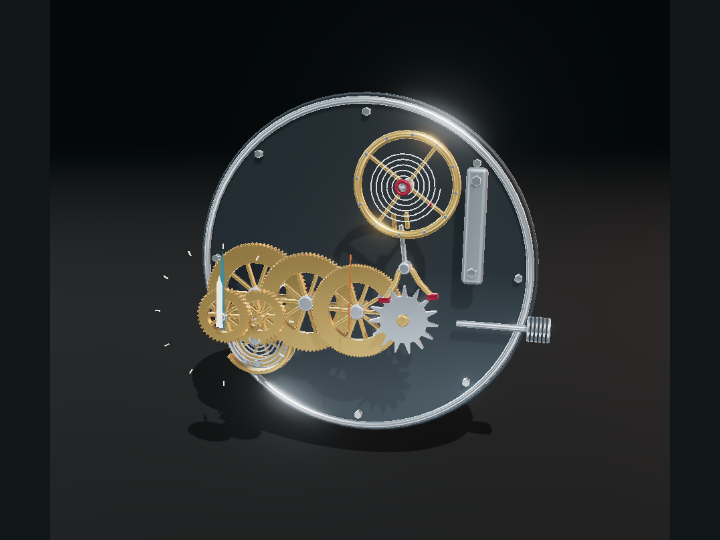
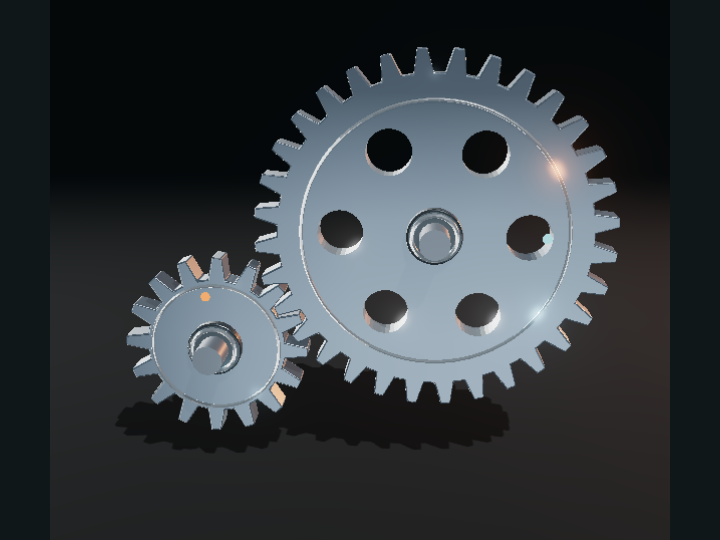
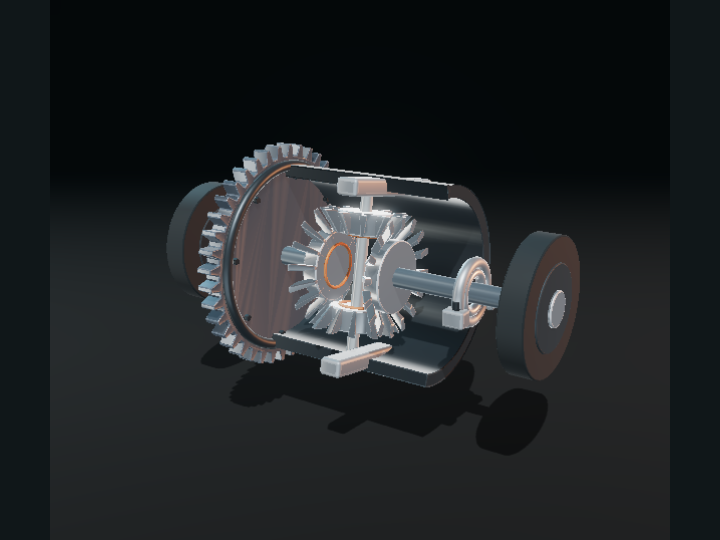
Each large wheel drives a small pinion on the next shaft. A second wheel shares that shaft and passes the motion onward.
The compound ratios turn the slow unwinding of the barrel into faster motion near the escapement. The shafts carry different rates through the movement.
TRY IT YOURSELF
Take the movement apart. Follow a large wheel to the smaller pinion on the next shaft.
Go deeper +
The visible train uses 80:10, 75:10 and 96:6 contacts. Tooth outlines are illustrative; pitch spacing and angular ratios are calculated.
As the balance swings through its center, the lever moves. One pallet releases; the escape wheel advances and is caught on the other pallet.
The same interaction gives the balance an impulse to replace energy lost during real operation. Holding and releasing connects the power source to the regulator.
TRY IT YOURSELF
Jump between Release and Hold. Notice that the escape wheel advances in steps, not continuous rotation.
Go deeper +
One complete balance oscillation has two beats. This 15-tooth teaching escape wheel advances one tooth over that complete oscillation.
The balance has inertia. Its hairspring supplies a restoring torque as the balance turns away from its resting position. Together they oscillate back and forth.
The escapement sustains that oscillation while the balance controls the rhythm of release. They exchange energy and timing information.
TRY IT YOURSELF
Compare 3, 4 and 5 Hz. Count two beats in each complete back-and-forth oscillation.
Go deeper +
For an ideal torsional oscillator, frequency depends on stiffness and rotational inertia. Changing frequency here is a comparison parameter, not a simulation of a specific regulating screw or adjustment.
The gear train turns repeated releases into motion of the seconds, minute and hour hands. Its fixed ratios are calibrated to a 4 Hz balance in this example.
Change the balance rate without changing those ratios and the hands run slow or fast. More beats in the same real time means more advance through the same train.
TRY IT YOURSELF
Set 3 Hz, then 5 Hz. Compare 0.75× and 1.25× hand rates with the 4 Hz baseline.
Go deeper +
The animation is slowed for inspection. The fixed train makes the fourth wheel turn once per 60 simulated seconds at 4 Hz; center and hour motion follow 60:1 and 12:1 reductions. No real-world accuracy is predicted.
Schematic overview. The explanation and equations remain available without JavaScript or 3D.
CHAPTER 1
A spring is the power source.
Turn the crown and a mechanism winds the mainspring inside its barrel. As the spring unwinds, it supplies torque to the gear train.
The watch needs a store of energy that can travel with you. A tightly coiled strip of spring steel fits inside a small movement.
The scene shows the energy path, not measured spring torque, winding, or depletion. The prescribed motion repeats without calculating a power reserve.
CHAPTER 2
A train of tiny gears.
Each large wheel drives a small pinion on the next shaft. A second wheel shares that shaft and passes the motion onward.
The compound ratios turn the slow unwinding of the barrel into faster motion near the escapement. The shafts carry different rates through the movement.
The visible train uses 80:10, 75:10 and 96:6 contacts. Tooth outlines are illustrative; pitch spacing and angular ratios are calculated.
CHAPTER 3
Keeping time begins with stopping.
An escape-wheel tooth rests against one of the pallet stones. The gear train cannot simply run freely, even though the mainspring supplies torque.
Without regulation, the spring would unwind too quickly and unevenly for useful timekeeping. The pallet fork controls the releases.
This is a schematic conventional lever escapement. Contact timing is prescribed; friction, impacts, drop and manufacturing tolerances are not solved.
CHAPTER 4
One beat releases a little motion.
As the balance swings through its center, the lever moves. One pallet releases; the escape wheel advances and is caught on the other pallet.
The same interaction gives the balance an impulse to replace energy lost during real operation. Holding and releasing connects the power source to the regulator.
One complete balance oscillation has two beats. This 15-tooth teaching escape wheel advances one tooth over that complete oscillation.
CHAPTER 5
The hairspring brings it back.
The balance has inertia. Its hairspring supplies a restoring torque as the balance turns away from its resting position. Together they oscillate back and forth.
The escapement sustains that oscillation while the balance controls the rhythm of release. They exchange energy and timing information.
For an ideal torsional oscillator, frequency depends on stiffness and rotational inertia. Changing frequency here is a comparison parameter, not a simulation of a specific regulating screw or adjustment.
CHAPTER 6
The hands count that rhythm.
The gear train turns repeated releases into motion of the seconds, minute and hour hands. Its fixed ratios are calibrated to a 4 Hz balance in this example.
Change the balance rate without changing those ratios and the hands run slow or fast. More beats in the same real time means more advance through the same train.
The animation is slowed for inspection. The fixed train makes the fourth wheel turn once per 60 simulated seconds at 4 Hz; center and hour motion follow 60:1 and 12:1 reductions. No real-world accuracy is predicted.
Sources, credits & model boundaries+
What this model explains
Unbranded, idealized hand-wound movement with a prescribed conventional lever escapement. Tooth shapes and contact geometry are teaching approximations. No force, friction, accuracy, power-reserve or spring-depletion simulation. Frequency presets hold the gear train fixed. No automatic winding, date or complications. Motion is slowed for inspection.
General mainspring, train, balance and escapement principles; this is not a model of a Grand Seiko calibre.
Made in the open
Original Blender movement, deterministic hairspring and educational text by OpenEngineering contributors, CC BY 4.0. Editable source and scripts/build-exhibit-models.py included. No branded calibre or copied CAD.
Code: MIT. Original educational content and assets: CC BY 4.0. No independent mechanical reviewer is credited yet.